
Abundance Without Meaning
AI, Robots, and the Crisis of the Human Person

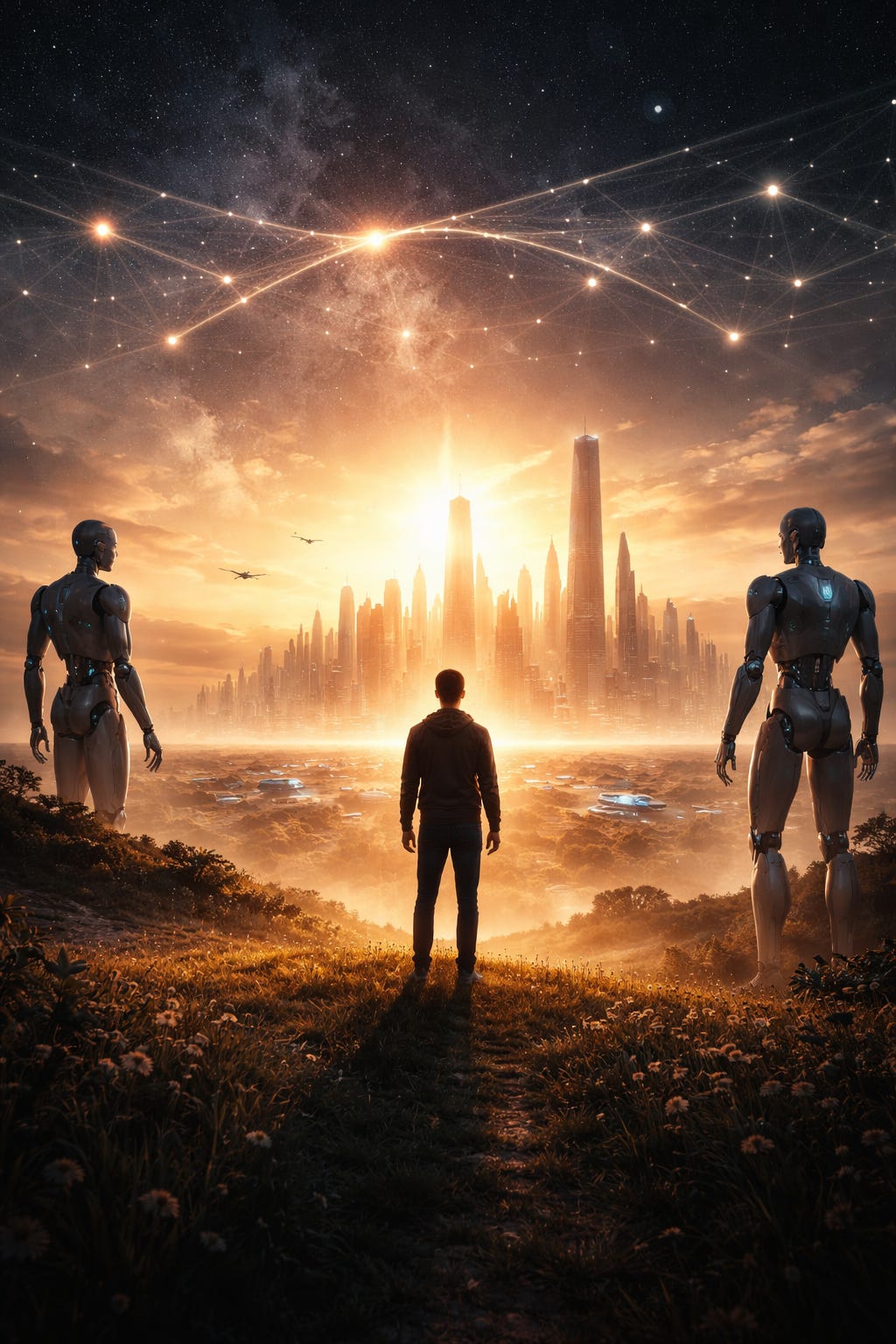
Elon Musk is not a nihilist.
Nor is he a cartoon villain, or a techno-messiah.
If you listen carefully to his recent remarks at Davos, a deeper concern emerges—one that is not fundamentally about profit, dominance, or even technology. It is about the miracle of consciousness.
Again and again, Musk returns to a single image: a fragile candle flickering in an immense darkness. Life, as far as we know, may be unimaginably rare. Consciousness may exist nowhere else in the universe. If that is true, then humanity bears a strange and sobering responsibility—not merely to survive, but to carry consciousness forward.
This is the animating vision behind his two most ambitious projects.
Tesla aims at abundance—energy, automation, robotics, and AI capable of saturating human needs so thoroughly that poverty itself becomes obsolete.
SpaceX aims at continuity—making life multi-planetary so that consciousness is not extinguished by a single catastrophe on Earth.
Taken together, they form a coherent worldview: secure abundance here; preserve consciousness beyond here.
And yet, Musk himself names the unresolved problem at the heart of this future.
If robots do all the necessary work… what happens to human purpose?
That question is not technical.
It is anthropological.
And it may be the defining question of the coming century.
The Two Futures We Already Know
We already have cultural myths that map the extremes of this trajectory.
On one end is WALL‑E—a grotesque parody of abundance without meaning. Human beings, fully cared for, fully entertained, fully optimized… and utterly infantilized. Bodies atrophied. Attention dulled. Desire flattened. No real work. No real suffering. No real becoming.
On the other end is The Matrix—a more elegant, more dangerous vision. Human bodies preserved. Nervous systems managed. Experience curated. Freedom felt subjectively, even while dependence is absolute.
Both futures share the same hidden structure:
delegated agency traded for comfort.
And this reveals the deeper tension:
Every optimization that gives us a sense of freedom also risks making us dependent on the system that optimized it.
This is not merely a political or economic problem. It is a spiritual one.
In older language, we would ask:
Is this an angel or a demon?
Not because technology itself is moral or immoral—but because every tool eventually reflects the spirit that animates its use.
Work Before the Fall
Christian anthropology offers a crucial correction here, one that neither techno-optimism nor techno-fear tends to grasp.
Work did not begin as punishment.
Before thorns.
Before sweat.
Before death.
God gives humanity a task:
“To till and to keep the garden.” (Gen 2:15)
This work is not about survival or productivity. It is about formation.
To till is to place seed into soil.
To keep is to guard, to tend, to remain in relationship.
Work, in its original form, is participation—a way the human person discovers reality, self, and God through embodied engagement with the world. It is not performance for worth. It is becoming through relationship.
This is why the coming crisis of automation will not merely be economic. It will be existential.
If human value has quietly been grounded in productivity—in what I do, produce, contribute, or optimize—then a world where machines do all necessary work will expose a terrifying vacuum.
Not because we are useless.
But because we forgot why we were ever working in the first place.
Performance Is Not Purpose
Here Christianity quietly diverges from both capitalist and technocratic narratives.
Jesus does not liberate humanity by maximizing output.
He liberates humanity from performance-based identity altogether.
Worth is no longer earned.
It is received.
This is precisely where many people will struggle in an AI-saturated world. If survival no longer requires effort, and meaning has been unconsciously tethered to effort, then abundance becomes disorienting rather than liberating.
And this is where a surprising voice becomes indispensable.
Viktor Frankl and the Last Human Freedom
In Man’s Search for Meaning, psychiatrist Viktor Frankl writes from the most extreme deprivation imaginable: the Nazi concentration camps.
Frankl observed something devastatingly simple.
Those who survived were not necessarily the strongest.
They were not the most intelligent.
They were not the most optimistic.
They were the ones who could still make meaning.
Even when stripped of freedom, dignity, identity, and future, the human person retains one irreducible power:
The freedom to choose the meaning of one’s response.
Frankl called this logotherapy—the healing power of meaning itself.
And this insight lands with shocking relevance in a future of abundance.
If suffering is no longer necessary for survival…
If work is no longer necessary for provision…
If effort is no longer necessary for comfort…
Then meaning will no longer be accidentally supplied by necessity.
It will have to be chosen.
The Real Fork in the Road
The future Musk imagines is not wrong. It is incomplete.
AI and robotics may indeed create material abundance beyond precedent. Space may indeed carry consciousness beyond Earth. Energy may become effectively limitless.
But none of this answers the deepest human question:
Who am I becoming?
The real fork in the road is not WALL-E versus The Matrix.
It is this:
A world where meaning is outsourced, simulated, or anesthetized
orA world where meaning is consciously cultivated—no longer grounded in survival, but in love, relationship, creativity, stewardship, and transcendence
Frankl would say: abundance does not destroy meaning.
It merely removes the illusions that were propping it up.
Christian theology would say the same thing, more bluntly:
Man cannot live by bread alone—even if the bread is infinite.
A Different Kind of Abundance
Perhaps the coming age will force a long-overdue reckoning.
Not What can we optimize?
But What is worth becoming?
Not What can machines do for us?
But What can only a human person do?
Love cannot be automated.
Suffering cannot be outsourced.
Meaning cannot be delegated.
In that sense, the future may not strip humanity of purpose—but of excuses.
And that may be the most hopeful possibility of all.
I think I would go one step further and say that meaning isn't just made but discovered. Our meaning has an Author, and it is through our seeking Him that it is found
Where is our focus and who is it that determines meaning and worth in our lives? Is it the capitalistic society we live in where we give great distiction to the have and have nots. Where success is linked to performance and how much you have...or do we see others through God's lens who does does not value the rich man over the destitute. The poor are actually the church's gift. Are we to overlook their gift? Does someone's inherent value and purpose lie in their performance? Does a society guided by a human's technological inventions really lead us to a more perfect society or down another rabbit hole?