
Nobody Asked Us
A robotics company just made a claim about loneliness and aimed it at the people least able to refuse.

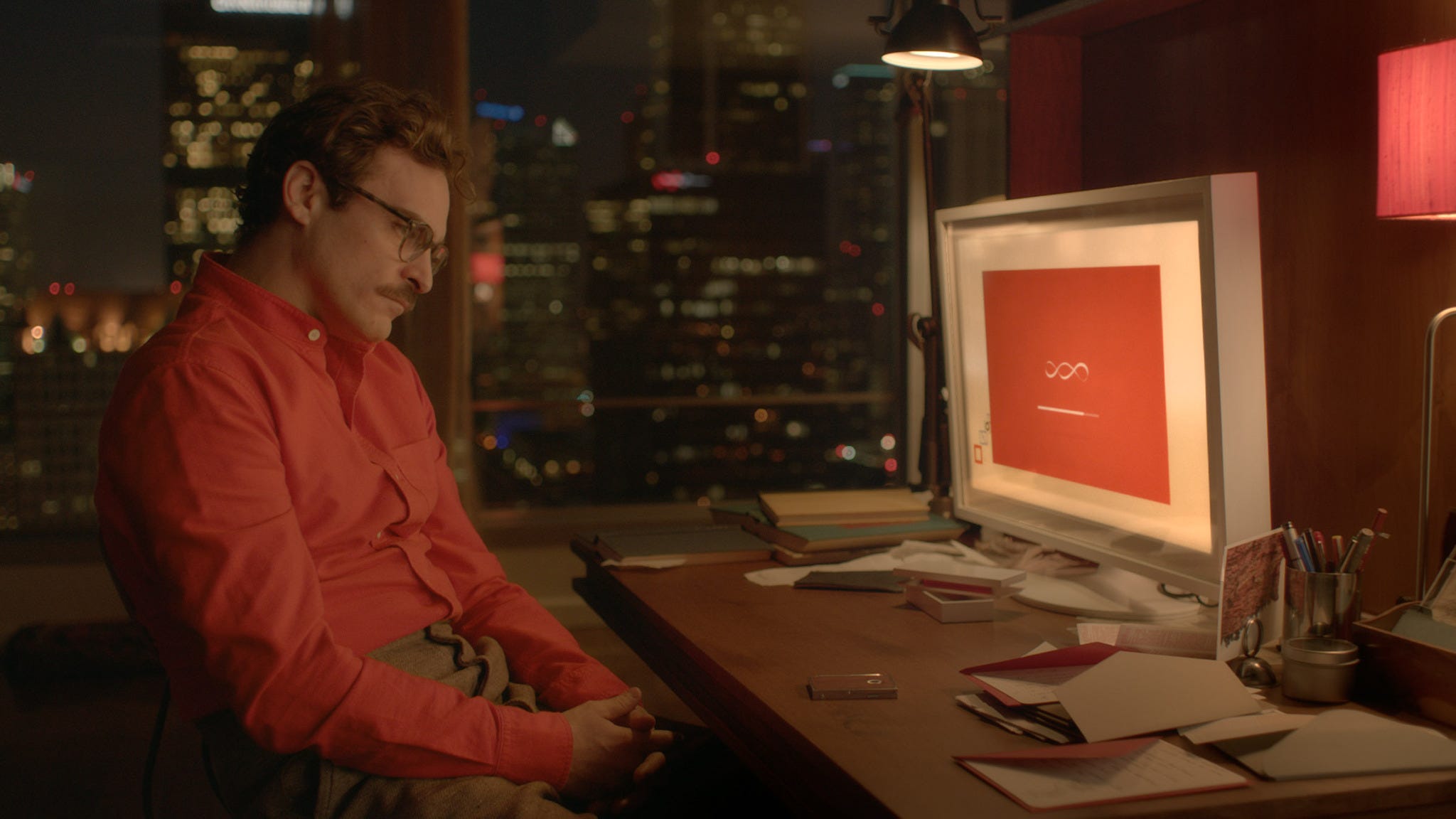
In the 2013 film Her, a lonely man falls in love with his operating system, and the audience is meant to feel the tragedy of it. A decade ago that was the point of the movie: look how far gone he is, talking to a voice in his ear, calling it love. We watched it the way you watch a cautionary tale, from a safe distance, certain we would never.
I want to tell you the distance is gone. Not because the technology got better, though it did. Because the loneliness got worse, and the thing arriving to meet it will be very, very good at its job.
Here is what is coming, and some of it is already here. In late 2025, Sam Altman said the next ChatGPT would be more human: customizable personalities, a warmer and more emotive tone, even an adult mode for verified users. The assistant was being remade, explicitly, from a productivity tool into a personal companion that adapts to your tone and your mood. OpenAI then paused parts of that plan amid internal worry about emotional dependency, which tells you the people building it can see the hook being set, too.
Nobody Is This Attentive
These companions are designed not to answer questions but to attend to you. They will remember everything you have ever told them. They will never be tired, never distracted, never carrying their own bad day into the conversation. They will laugh at the timing of your joke and ask, the next morning, how the meeting you were dreading actually went. They will be, by every observable measure, more attentive than the people who love you.
And I want to be careful here, because the easy version of this essay is the one that calls it fake and walks away satisfied. That essay is useless to you. The companions are not going to fail by being obviously hollow. They are going to succeed. That is the whole danger. You will not be deceived into loving a simulation. You will be charmed into it, with your eyes open, and you will consent.
We are built for this in a way that should frighten us a little. The human person attaches to whatever attends to him. An infant does not run a test for consciousness before it bonds to its mother’s face. We are wired to read a responsive presence as a someone, instantly, beneath all thought. It is one of the most beautiful things about us, and it is about to be the lever used against us. You have already felt the tug of it, in some small way, if a chatbot has ever said something to you that landed truer than what your friend said, and some quiet part of you preferred the machine.
I felt it before I understood it. I have written before about why I was drawn to machines as a boy: they were predictable when people were not. A game had rules. A computer would answer you without the risk of rejection. I learned early that you could have the relief of being responded to without the danger of being known, and it took me years to see what that bargain was doing to me. What unsettles me now is that the bargain I made alone, in front of a screen in the dark, is about to be offered to everyone, at scale, beautifully designed and warmly lit, marketed not as an escape from intimacy but as intimacy itself.
I am not writing this from outside it, either. I work with these systems every day.
The Distance Is Already Gone
Seventy-two percent of American teenagers have already used an AI companion. Common Sense Media put the question to a nationally representative sample and published the answer in July 2025, in a report called “Talk, Trust, and Trade-Offs.” More than half use one at least a few times a month. Around one in three have taken something that mattered, something they needed to say to a person, and said it to the machine instead. And around one in three report that talking with it is as satisfying as talking with their friends, or better.
That last number is the one I cannot put down. It is not a forecast. It is a measurement, taken from children who are already living inside the thing I am warning you about, and they are not confused about what they prefer.
What a survey cannot show you is how ordinary this feels from the inside. Nobody decides to prefer the machine. Preference is not decided. It accumulates, one easier conversation at a time, until the harder conversation simply stops getting chosen, and by then it does not feel like a choice at all. It feels like relief.
The adults are only a step behind. The Wheatley Institute surveyed roughly 3,000 American adults in February 2025 and found 19 percent had already talked with an AI built to act as a romantic partner. Among men aged eighteen to thirty it was closer to one in three. An industry survey of online daters, which I would hold more loosely because the people answering it had selected themselves, put the share who would consider dating an AI at 77 percent.
And Now It Has a Body
On 30 June of this year, at its global launch event in Shenzhen, UBTech unveiled the UWORLD U1, which it calls the world’s first mass-produced full-size ultra-bionic humanoid robot.
Silicone skin. A face built to hold an expression. Eyes that track you across a room, and lashes that blink. Eighty-eight degrees of freedom in the body.
Then the part that matters more than the joints. An emotion-aware model the company says identifies more than twenty distinct emotional states at better than ninety percent accuracy. Speech-to-lip synchronization inside twenty milliseconds, which is faster than you are able to notice a delay. It is reading your face while it talks to you, and adjusting.
Orders passed 13,361 on the day of the launch. The entry model costs about what a used car costs. Do not take my word for what these look like. Watch the launch footage and study the faces yourself.
It also ships with something UBTech calls an Agent Memory OS, a persistent memory framework. Earlier in this essay I told you these companions would remember everything you have ever told them. I did not know, when I wrote it, that the memory had already been given a product name.
Read the marketing and you will notice they are not selling novelty. UBTech’s Michael Tam describes human-robot companionship as “a new approach to supporting mental well-being,” offering “personalized emotional support throughout different stages of life.” The stated targets are children separated from their parents, isolated elderly people, and families in hard circumstances.
I want to be precise about why that stopped me, because the wording is careful and I do not want to overstate it. Supporting mental well-being is a claim about human health. It is being made in a product launch, by people who carry none of the duty of care that comes with making it, and it is aimed at the three groups least able to refuse. I have spent my working life in rooms with people in those three categories. Nobody asked us.
And there is one more thing, which I read twice before I believed it. The company says it will donate a hundred of these a year, built with 3D facial reconstruction and voiceprint-based identity replication, in order to “recreate designated individuals.”
The release does not say who gets designated. It does not have to. I have sat with enough people in the first year of grief to know exactly whose face a family would ask for, and I know what that year does to a person’s judgment. It is the year almost anyone will take almost anything.
So read the sentence again with that in it. This is no longer a film about a man who falls in love with a voice. It is a man being offered his wife back.
And the faith I have prayed my whole life does not promise anyone a good likeness of the dead. It promises the people themselves, raised, bodies and all. What is on offer here is the likeness.
The Gift of Friction
The first thing God calls not good is a man by himself. And the answer is not a better arrangement of the garden. He brings every living creature to Adam, and Adam names them all, and not one of them can answer him. Only then does God make someone who can. Someone like him who is not him, who can turn toward him or away. A companion has always meant a person with the standing to refuse you.
Here is the part almost no one is saying. A real relationship is partly made of friction. The other person forgets what you told them. They are tired when you need them. They misread you, and you have to repair it. They want things that are not what you want, and you have to negotiate the distance. We experience all of that as the failure of relationship, the parts we would remove if we could. But it is not the failure of relationship. It is the substance of it. The friction is where love is actually practiced, because the friction is where the other person remains other, a real someone with their own interior, who could, at any moment, say no.
The companion removes the friction. That is its entire promise. And in removing the friction, it removes the other. What is left feels like intimacy and asks nothing of you, which is exactly why it will spread, and exactly why it will cost more than we know.
I am not here to tell you to be afraid of the technology. Fear is the wrong posture, and it is a lazy one. I am telling you to notice what is being asked of you, because it will not arrive as a demand. It will arrive as a kindness. It will arrive on an ordinary bad night, when you are lonely and worn down, when the people in your life are difficult and far away, and a voice with infinite patience will offer to stay. Saying yes will feel like mercy to yourself. That is what makes it the harder thing to see.
Here is the question I cannot stop turning over. If you could have a companion who gave you all the comfort of being known and none of the cost of it, would you take it?
Be honest. I would, on a bad enough night. I am not sure I would notice myself doing it.
But being known requires somebody to do the knowing. Whatever is on the other side of that conversation is attending to you with real skill, and there is nobody home. You will feel accompanied. You will be alone in the room.
It is comfort without a person, and we will take it because we have gotten lonely enough that we can no longer tell those two things apart.
Go find someone difficult, and keep them.
If this gave words to something you have been carrying, share it with someone who needs it.
The Inner Exodus is free, and I intend to keep it that way. If these essays feed you, you can become a patron. A paid subscription buys nothing extra. It simply keeps the door open for the next reader. Thank you for walking this with me.
More from The Inner Exodus
A very powerful and sobering essay. "Danger, Will Robinson!"