
I Wrote This With AI
On Genius, Cheapened Signals, and the Ceiling That Machines Cannot Reach

I thought through much of this article while rollerblading in Santa Monica, talking out loud to Meta AI through my glasses.
Later, I sat back as Full Self-Driving handled the long stretch to Malibu for an early surf, continuing the same conversation. There’s something surreal about being chauffeured by your own car while debating the implications of artificial intelligence. The steering wheel turns. The traffic flows. And you’re left with mental space you didn’t used to have.
What struck me in those moments wasn’t that technology was replacing me.
It was that it was creating space.
As a psychotherapist, I spend my days listening beneath language. I listen for what is under the words. For the emotional charge not yet named. For the meaning that precedes explanation. My work is not about producing speech. It’s about discerning what is actually there.
My writing has slowly become an extension of that.
Less performance.
More integration.
More talking things out.
More listening for what feels true, what feels off, what feels unfinished.
AI, in that sense, has functioned like a conversational mirror. It can hold structure while I explore. It can keep context steady while I circle a thought from different angles. It can help organize what was first spoken into the air.
But it cannot decide what matters.
That still requires discernment.
And that question — what technology is shaping in us — eventually led to a deeper conversation.
The Conversation About Genius
A recent exchange with a subscriber sharpened this tension. She raised a serious concern: Would a mind like Aquinas even develop in an environment like this? If powerful generative tools are introduced too early, do they stunt cognitive development? Does genius require friction? Does slow intellectual struggle form something that shortcuts cannot?
This is not paranoia.
We have already watched what technology does to formation. Calculators improved efficiency but weakened mental arithmetic. GPS made navigation effortless but reduced spatial memory and our internal sense of direction. The internet gave us instant access to information but shortened attention spans and weakened recall. Since around 2010, researchers have tracked measurable declines in sustained attention and deep reading capacity, especially among younger generations immersed in constant digital stimulation.
We gain something. We lose something.
AI will not be exempt from that pattern.
If generative systems are introduced before a person has wrestled through the cognitive work themselves — constructing arguments, memorizing texts, struggling to articulate ideas slowly — there is a real possibility of premature optimization. If you never strain to build the muscle, the muscle does not develop in the same way.
Formation requires friction — not as punishment, but as development.
Aquinas did not become Aquinas because he lacked tools.
He became Aquinas because of sustained engagement. Silence. Discipline. Argument. Study under masters. A life ordered around contemplation and prayer. He inhabited his questions long enough for them to shape him.
Writing itself did not create his genius. Engagement did.
Anything we give ourselves to deeply will shape us. Writing can do that. Speaking ideas aloud can do that. Sitting in silence can do that. Wrestling with objections can do that. Prayer can do that.
The danger is not that AI exists.
The danger is that we bypass the struggle that forms judgment.
And judgment — not output — is what genius ultimately requires.
The Cheapening Effect
There is also a more immediate emotional reaction happening.
People feel something has been cheapened.
When formatting can be replicated, when tone can be approximated, when competence can be generated quickly, it destabilizes long-standing signals of excellence. Articulation no longer proves depth. Polish no longer guarantees formation. Effort becomes harder to see.
And for many, that feels unsettling at a deeper level than they realize.
Because for years, craft was a kind of currency. Time invested translated into visible distinction. The ability to write clearly, compose beautifully, design skillfully, argue coherently — these were markers that someone had paid a cost. That cost created respect.
Now the floor has risen.
Competence can be approximated in seconds. Structure can be automated. Tone can be mimicked. And suddenly the old signals feel unreliable.
For artists and writers, this can feel threatening. Years of practice appear easier to approximate. The barrier to entry lowers. The baseline rises.
But beneath the anxiety is something even more human.
If everyone can “sound smart,” what distinguishes the truly wise?
If everyone can generate images, what distinguishes the artist?
If everyone can draft essays, what distinguishes the thinker?
The destabilization is not only economic; it is existential.
If polish is no longer proof of depth, how do we recognize depth?
And if distinction becomes easier to simulate, how do we measure what has actually been earned?
This is the cheapening effect.
But it only cheapens what was never the ceiling to begin with.
AI raises the floor. It does not raise the ceiling.
The floor is the minimum standard of competence — structured, coherent, presentable output. The baseline quality that becomes widely accessible.
The ceiling is something else entirely.
The ceiling is depth of integration.
It is embodied skill developed over time.
It is moral weight carried responsibly.
It is coherence across seasons.
It is a life that must live downstream of its own ideas.
The ceiling is not technical perfection.
It is meaning.
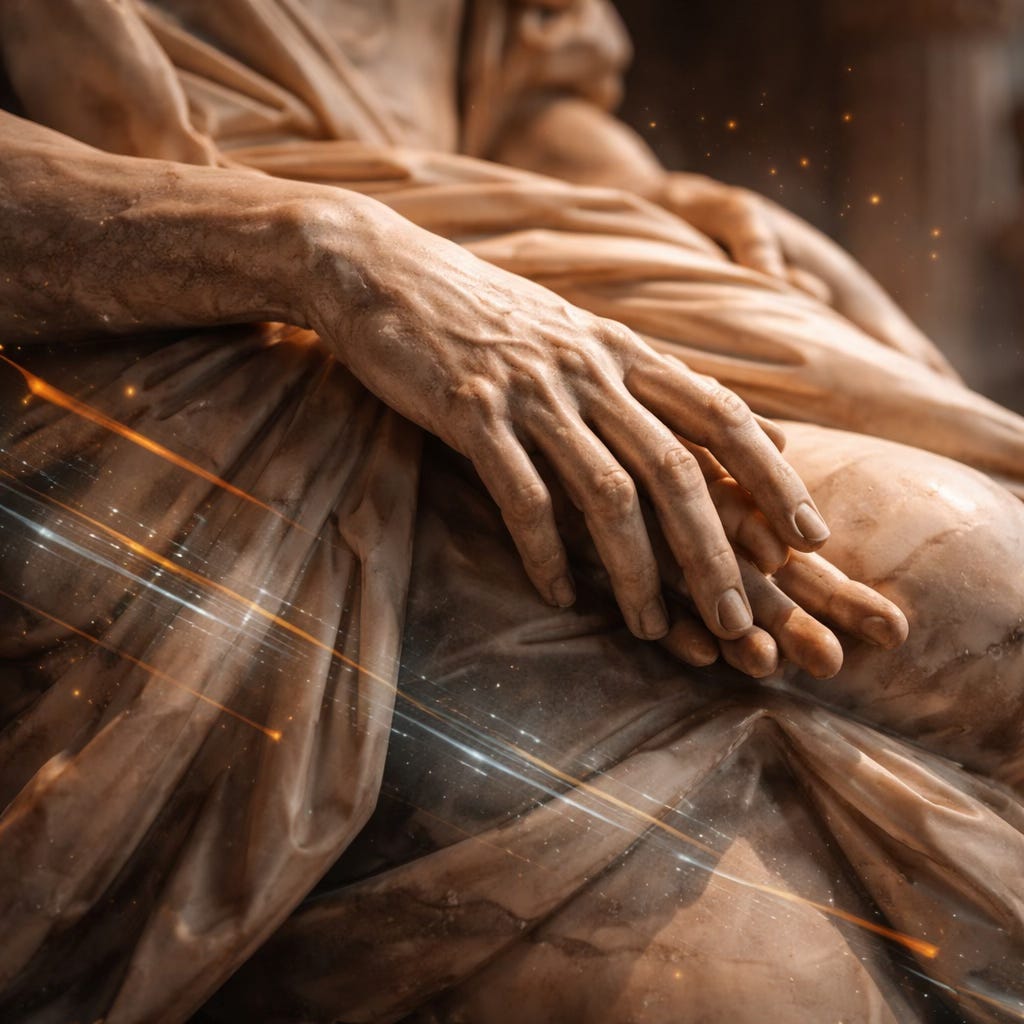
Even if AI could sculpt something technically more precise than Michelangelo’s Pietà, it would never replace what the Pietà actually is: a particular body, carved in a particular historical moment, by a particular human being whose devotion, training, imagination, and embodied skill converged in that marble.
The story matters.
The body matters.
The hand matters.
We are not at the end of creativity. We are at the end of old signals.
AI may raise the floor of production, but the ceiling remains human.
Augmentation vs Replacement
This is the line that matters most to me: augmentation versus replacement.
Augmentation keeps me engaged.
Replacement allows me to disengage.
When I’m rollerblading and talking through an idea, refining it on a long drive to surf, editing, questioning, rejecting what doesn’t sit right, praying over what feels true or false — I am still doing the work. The tool may assist the process, but it does not carry it.
That is augmentation.
Replacement looks different. It is output without wrestling. Language without interior cost. Delegating not just mechanics, but judgment. Allowing the system to determine direction instead of forcing yourself to decide.
And this is where the issue deepens.
Discernment is not simply refining what has been generated. It is deciding what deserves attention in the first place.
What is worth thinking about?
What is worth amplifying?
What is worth building a life around?
AI can generate options. It can optimize outcomes. It can summarize trends and simulate likely probabilities. But it cannot feel moral weight. It cannot sense gravity from the inside. It cannot distinguish between what is interesting and what is meaningful.
Wisdom is not selecting the most efficient answer.
Wisdom is recognizing which questions are worth asking at all.
The tool is not the moral problem.
Disengagement is.
Authentication in a Robotic World
As AI becomes more pervasive, human authenticators will matter more, not less.
When formatting can be replicated and tone can be simulated, we will instinctively look beyond output. We will ask quieter questions.
Who is this person over time?
Do they live what they write?
Are they accountable to anyone?
Have they demonstrated coherence across seasons?
Trust will not be built on polish. It will be built on history.
In a world where text can be generated and presence can be mimicked, relational continuity becomes the anchor. The people we have observed. The voices we have followed. The mentors who have shown up consistently. The friends who have earned credibility through lived alignment.
We will rely more heavily on embodied reference points — not because technology fails, but because authenticity is relational by nature.
AI can produce words. It cannot produce character.
It can simulate tone. It cannot live a life.
That is why dismissal based solely on formatting will miss the point. And blind acceptance based solely on polish will miss it too.
The real question will not be, “Was this assisted by AI?”
The real question will be, “Who is the human behind this, and do I trust them?”
In the end, authenticity will not be measured by stylistic purity.
It will be measured by coherence between words and life.
The Strange Sentence
And so we arrive at a sentence that feels honest for this moment.
I wrote this.
And I didn’t write this.
The ideas were formed in conversation — with clients, with subscribers, with friends. They surfaced while skating, while driving, while praying, while sitting quietly and letting something deeper rise. A tool helped structure them. It did not give them weight.
That distinction matters.
We are entering a world where the floor is rising quickly. Competence will become easier. Structure will become automatic. Output will multiply.
But the ceiling is not structure. The ceiling is discernment.
The ceiling is the ability to recognize what is worth giving your attention to. What is worth amplifying. What is worth shaping a life around.
AI can assist in expression.
It cannot determine importance.
It can generate options.
It cannot assign moral gravity.
It can simulate coherence.
It cannot live downstream of its words.
The tool is powerful.
The responsibility remains human.
The floor is rising.
The ceiling is still ours to cultivate.
And that cannot be outsourced.
Thank you Sean! I really enjoy reading your articles and find that your thoughts have the weight of experience and authenticity which coincide with meeting you in person and worshipping with you at the Onething Conference and Encounter and CCRNO Conference. I have limited experience with the technology of AI, just the biased output of Grok. So there is another problem of inputting biased content into AI (for another time).
Maybe I have read more AI generated articles than I realize and dont really pay attention to that fact and was kind of hoping I wasnt being deceived by AI .:.was that really you on that video, of was it AI generated to look and sound exactly like you?
People will not have the moral compass that you do in using this type of technology, so I pray that we are ready for unformed and undiscerning people to take the helm of short cuts and forgery. Haha!
My son and daughter-in-law and I were just discussing this. I very much appreciate you sharing your thoughts. I think we agree with you. “ Formation requires friction — not as punishment, but as development.” Yet, using AI does not necessarily preclude that friction, or “doing the work”.