
The Children’s Bread
Deliverance, Faith, and the Power of Beholding Jesus

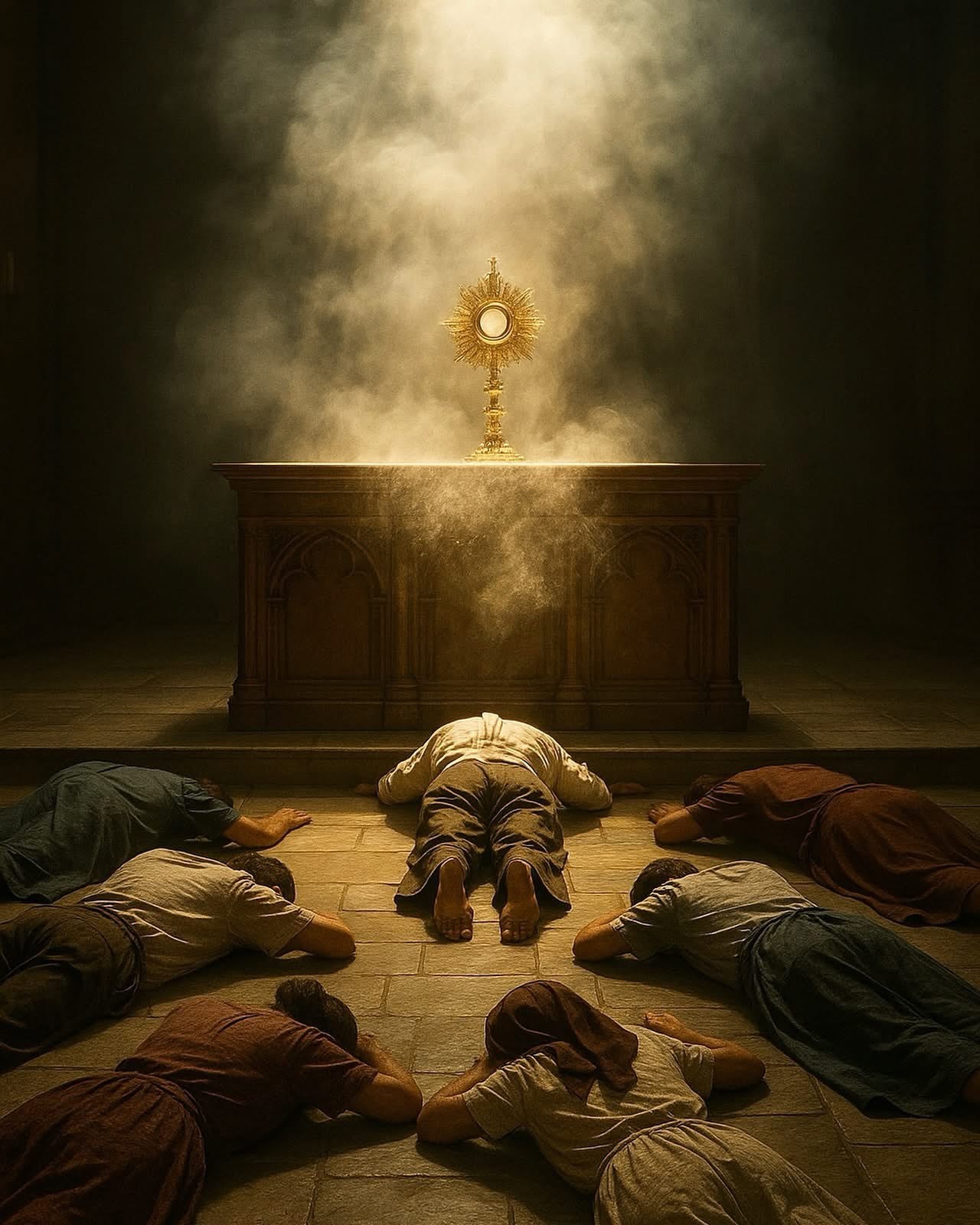
There is a moment in the Gospels that unsettles us if we let it.
A Syrophoenician woman—a Gentile, a Canaanite by lineage—comes after Jesus, crying out for her daughter who is tormented by a demon. She does not approach politely. She presses in. The apostles are uncomfortable. They want her sent away. And then Jesus says something that, on the surface, sounds like a refusal:
“It is not right to take the children’s bread and throw it to the dogs.” (Mk 7:27)
Yet this is not dismissal. It is revelation.
Because she answers—not offended, not retreating—but with astonishing clarity of faith:
“Yes, Lord—but even the dogs eat the crumbs that fall from the master’s table.” (Mt 15:27)
Jesus marvels. He does not rebuke her, He praises her faith, and her daughter is healed at a distance—by a word alone!
This is not little faith—like the apostles’ faith.
This is great faith! Arguably greater even than that of the Roman centurion.
She does not assert position. She does not ask for spectacle. She does not demand touch. She asks only that the Bread speak.
The Children’s Bread Is Not Earned
Here is the first truth this passage reveals:
Deliverance is not something we earn.
It is something we receive from a good Father.
Jesus calls it the children’s bread. Not the reward of the worthy. Not the prize of the elite. Bread is daily food. It is sustenance. It is given to children because they belong—and it is for them, that He is there.
Deliverance, healing, freedom from the works of the enemy—these are not advanced techniques reserved for specialists. They flow from sonship. Spiritual adoption.
This is why I often say—deliberately—that every believer can be a “simple exorcist” (not a major exorcist with the formal rite—that belongs properly to those with delegated authority and holy orders). A simple exorcist is simply someone who:
Knows they belong to the Father
Knows the authority of the Son
Stands in the power of the Holy Spirit
And speaks in faith, without striving
Freedom is not earned by intensity.
It is accessed by relationship.
Discerning the Bread
Saint Paul gives us a sober warning:
“Anyone who eats and drinks without discerning the body eats and drinks judgment on himself… that is why many of you are weak and ill, and some have died.” (1 Corinthians 11)
This is not about fear. It is about discernment.
If failing to discern the Bread can bring sickness, then rightly discerning the Bread must also bring healing.
And here we arrive at the second truth:
Healing is not merely spiritual—it is integrative.
Mental, emotional, physical, and spiritual healing belong together, ordered toward union with God.
As we learn to heal dis-ease—the interior fragmentation that precedes disease—we should expect to see more and more manifestations of healing through the Eucharist itself. Not as magic. Not as technique. But as communion rightly beheld.
Behold the Lamb of God
John the Baptist does not say, “Understand the Lamb of God.”
He says, “Behold.”
In English, we use seeing in at least three ways:
I see — meaning, “I understand.”
I see — meaning, “I perceive with my eyes.”
I see you — meaning, “I behold you, I take you in, I know you from within.”
The Greek sense of behold belongs to the third.
It is the same depth of seeing Jesus refers to when He says that a man can commit adultery in his heart by the way he looks. Seeing is never neutral. It always participates.
We become what we behold.
When we behold the Lamb of God, we do not merely observe Him—we are drawn into communion.
This is why Jesus Himself compares His lifting up to Moses raising the bronze serpent in the wilderness. Those who looked were healed.
Christ lifted on the Cross is the Tree of Life.
And Revelation tells us that “the leaves of that tree are for the healing of the nations” (Rev 22:2).
"I look at him and he looks at me": this is what a certain peasant of Ars used to say to his holy cure about his prayer before the tabernacle. This focus on Jesus is a renunciation of self. His gaze purifies our heart; the light of the countenance of Jesus illumines the eyes of our heart and teaches us to see everything in the light of his truth and his compassion for all men. Contemplation also turns its gaze on the mysteries of the life of Christ. Thus it learns the "interior knowledge of our Lord," the more to love him and follow him. (Catechism of the Catholic Church, #2715)
A Pandemic Moment of Glory
During the early days of COVID, at an Encounter conference in Brighton, Michigan, something extraordinary unfolded.
During Eucharistic adoration, Father Patrick Gonyeaux processed through the room with the Blessed Sacrament.

He stopped before a man with one blind eye and held the Eucharist close in blessing.
Suddenly, Father Patrick asked for a microphone.
The man could see.
The room REJOICED!
The rest of the procession took on a greater enthusiasm. Then, Jesus was placed back on the altar. But instead of reposing, and breaking for lunch, no one wanted to leave.
Adoration continued throughout the afternoon.
Later, in the silence, a woman in the back of the room cried out:
“I can see! I can see! I can see!”
She ran forward, describing what she could now see clearly. Many had already slipped out for lunch—but those who remained were witnessing something unmistakable. She had significant nearsightedness, that somehow was spontaneously healed!
Still later, a few of us from the Encounter Los Angeles campus were praying over a group of religious sisters who had lingered…
As sisters do, near the Lord…
Over one sister, we received a word of knowledge—seeing in her the Sacred Heart. Which turned out to be her religious name! As we prayed over her hands, they began to glisten—like oil, sprinkled with gold dust.
It became clear she carried a gift of healing, which confirmed supernaturally what Jesus was awakening in her. The bridegrooms gifts belong to the bride.
None of this was about us.
It was about beholding Him rightly. And Him… King of Glory. Gracious. Kind. Compassionate. Gentle… We begin to connect with the One who has always beheld us.
Mary and the Eucharistic Pattern
In Scripture—as we pray our way into the posture of the disciples that Jesus loved—Jesus directs us to “Behold, your Mother” (Jn 19:27).
When we behold Mary, we do not divinize her.
We see divinized humanity by grace.
She shows us our capacity to host God—to be Temples of the Holy Spirit (something never said even of the prophets).
The Eucharist is the most substantial way we can experience this reality in this life. It is the re-presentation of Christ’s total self-gift—first to Mary, then to the Church.
As St. Cyril of Alexandria taught, “when one receives the Eucharist, it is as if two pieces of wax fuse to become one.”
But we do not consume God.
He is an “all-consuming fire” (Heb 12:29).
If we allow Him, He consumes us.
Dying of Joy
The saints understood this.
St. Catherine of Siena lived for years sustained almost entirely by the Eucharist.
Servant of God, Luisa Piccaretta did the same.
Blessed Imelda Lambertini longed for the Eucharist but was told she was too young. One day, overwhelmed with desire in prayer, the Eucharist was seen hovering above her head. The priest, moved by what he witnessed, gave her Communion.
She died immediately—of joy.
Afterall, St. John Vianney said it plainly:
“If we knew how much God loved us, we would die of joy.”
The Crumbs Are Enough
The Syrophoenician woman did not ask for the whole loaf.
She trusted the power of the crumbs.
And Jesus gave her everything.
The children’s bread is not withheld.
It is not earned.
It is not scarce.
It is given to those who belong—and even to those bold enough to believe that belonging is nearer than they were ever told.
Behold the Lamb of God.
And receive the Bread that heals.
Excellent piece Dr. Tobin!
Thanks to you I am in Encounter year 1.
As I struggle through it, your articles are perfectly timed and speak to my heart.
Wonderful!