
AI Is a Left Brain Tool
What AI can optimize and what it cannot touch

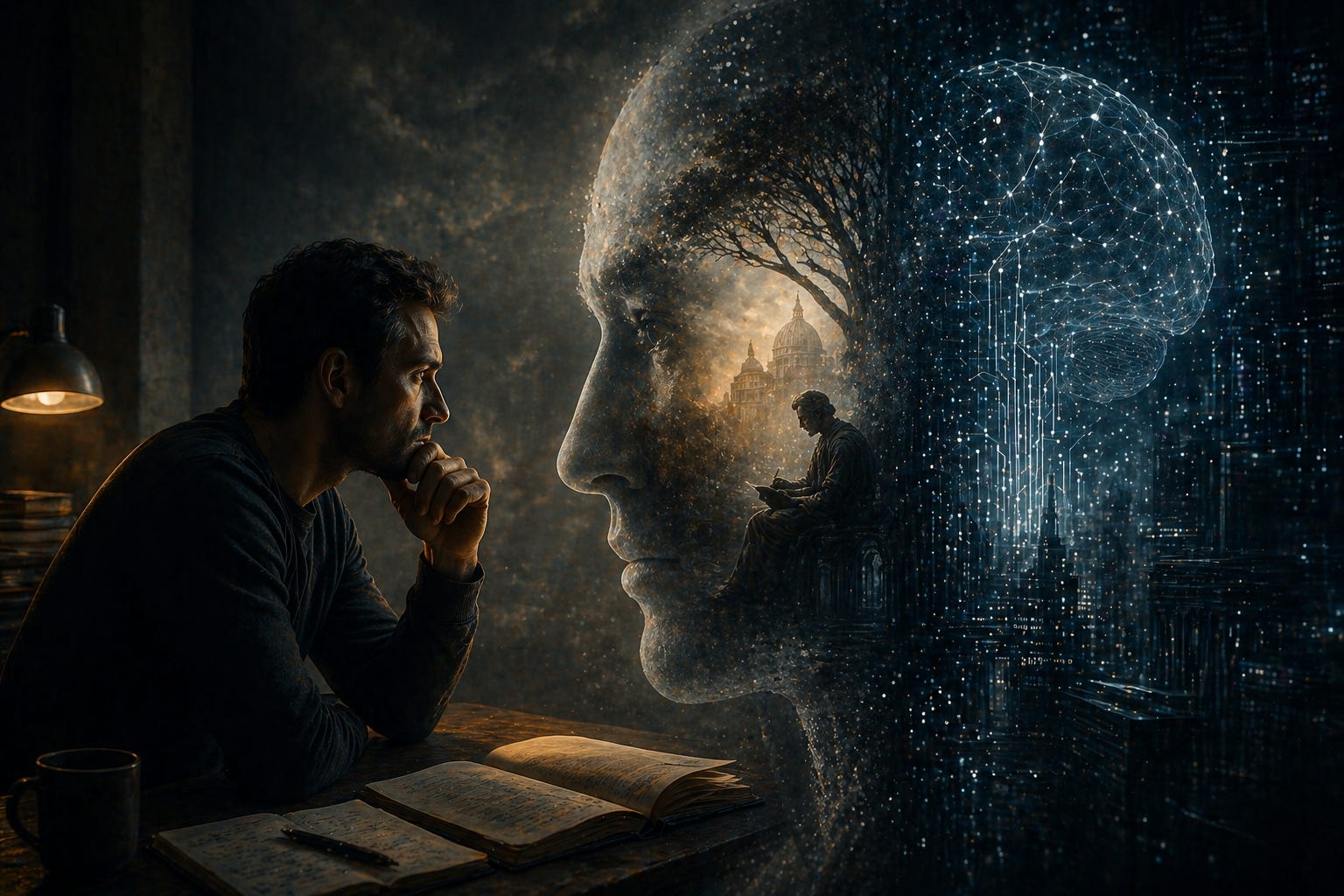
Arthur Brooks has a distinction worth sitting with.
There are, he says, two kinds of problems. Complicated ones and complex ones. Complicated problems have solutions — they yield to sufficient analysis, the right expertise, enough compute. Complex problems are different. They don’t resolve. They require you to live inside them. Love is a complex problem. So is grief. So is meaning. So is God.
AI, he argues, is a left hemisphere tool. Extraordinarily powerful for the complicated. Useless — and potentially dangerous — for the complex.
If you use AI to fill the spaces that only relationship can fill, you will become lonelier, not less.
I think he is right. And I think most of us are not taking it seriously enough.
The Confession Underneath the Productivity Pitch
There is a pattern I keep noticing in the way people talk about AI and what they hope it will do for them.
The pitch is always efficiency. Automate the repetitive work. Eliminate the friction. Buy back fifteen hours a week. Get more done in less time. And then — this is the part that reveals everything — invest that recovered time in what actually matters.
What actually matters, according to almost everyone making this argument? Presence. Connection. Their children. Their relationships. The human things.
Which raises an obvious question nobody seems to want to ask: if those are the things that actually matter, why did they disappear in the first place? Why do we need an AI system to recover the time for the life we actually want?
The honest answer is that the problem was never the calendar. The problem is what we do when the calendar clears. And that problem is not a scheduling problem. It is a formation problem.
Presence is not a residual. It is not what is left over after the tasks are handled. It is a practice, a discipline, a capacity that atrophies when unexercised — regardless of how much margin you have created.
What the Desert Fathers Knew
The fourth-century desert fathers and mothers were not running from busyness. Many of them had not been particularly busy before they left. They were running from something more subtle: the way the surface of life — even a manageable, comfortable surface — can absorb all attention if the interior is not deliberately cultivated.
Abba Moses gave this instruction to a young monk: stay in your cell and your cell will teach you everything. Not: optimize your cell. Not: automate your cell. Stay.
The wilderness tradition is not anti-technology. It is anti-distraction. It is a sustained argument that the self must be formed in a particular direction — toward silence, toward receptivity, toward God — and that this formation requires something more costly than time.
It requires attention. Directed, sustained, chosen attention — given not to a task but to a person, to God, to the interior life that has been quietly running on empty beneath all the productivity.
You cannot outsource attention. That is the irreducible thing. No system, however well-designed, can attend on your behalf. The attending is the formation. And formation is the only thing that produces the capacity for the right hemisphere goods — love, presence, genuine encounter — that everyone says they want.
Why Efficiency Cannot Get You There
The man who has never learned to be still will not suddenly be still because his afternoon is clear. The person who has spent years in reactive mode, whose nervous system has been tuned to urgency and stimulation, does not automatically shift into contemplative depth when the urgency is offloaded to an agent.
Formation does not work that way. It is not a function of available time. It is a function of chosen attention, sustained over months and years, in the direction of what is real.
This is what every serious spiritual tradition has always known, and what the productivity conversation keeps almost saying and then retreating from. The efficiency tools can clear the calendar. They cannot build the interior. They can give you the hours. They cannot give you the person capable of filling them with something that actually matters.
The Right Question
Brooks is correct that the right hemisphere problems are the ones that actually matter. Love. Friendship. Worship. Nature. Beauty. These are not amenities available once the left hemisphere work is done. They are the point.
But the implication he leaves unspoken is the most important one: if you want to be genuinely capable of those goods — not just theoretically available for them, not just present in body while absent in attention — you will need to be formed for them. That formation does not happen in the efficiency margin. It does not emerge from having more free time.
It happens in the choosing, again and again, to attend to the real. To sit in the cell. To stay when the restlessness says leave. To resist the pull toward stimulation long enough for something quieter to become audible.
AI is a left brain tool. A genuinely useful one.
The inner exodus is not a left brain event. It never was.
If this landed for you — forward it to someone who needs to hear it. The right hemisphere problems are worth talking about.
The Inner Exodus goes deeper into what formation actually requires — the contemplative, the theological, the psychologically honest. Paid subscribers get the pieces written for people who are serious about the interior life, not just curious about it.