
Pronouns, Gender, and the War on the Body
Why the AI Age Is Making the Trans Debate Impossible to Avoid

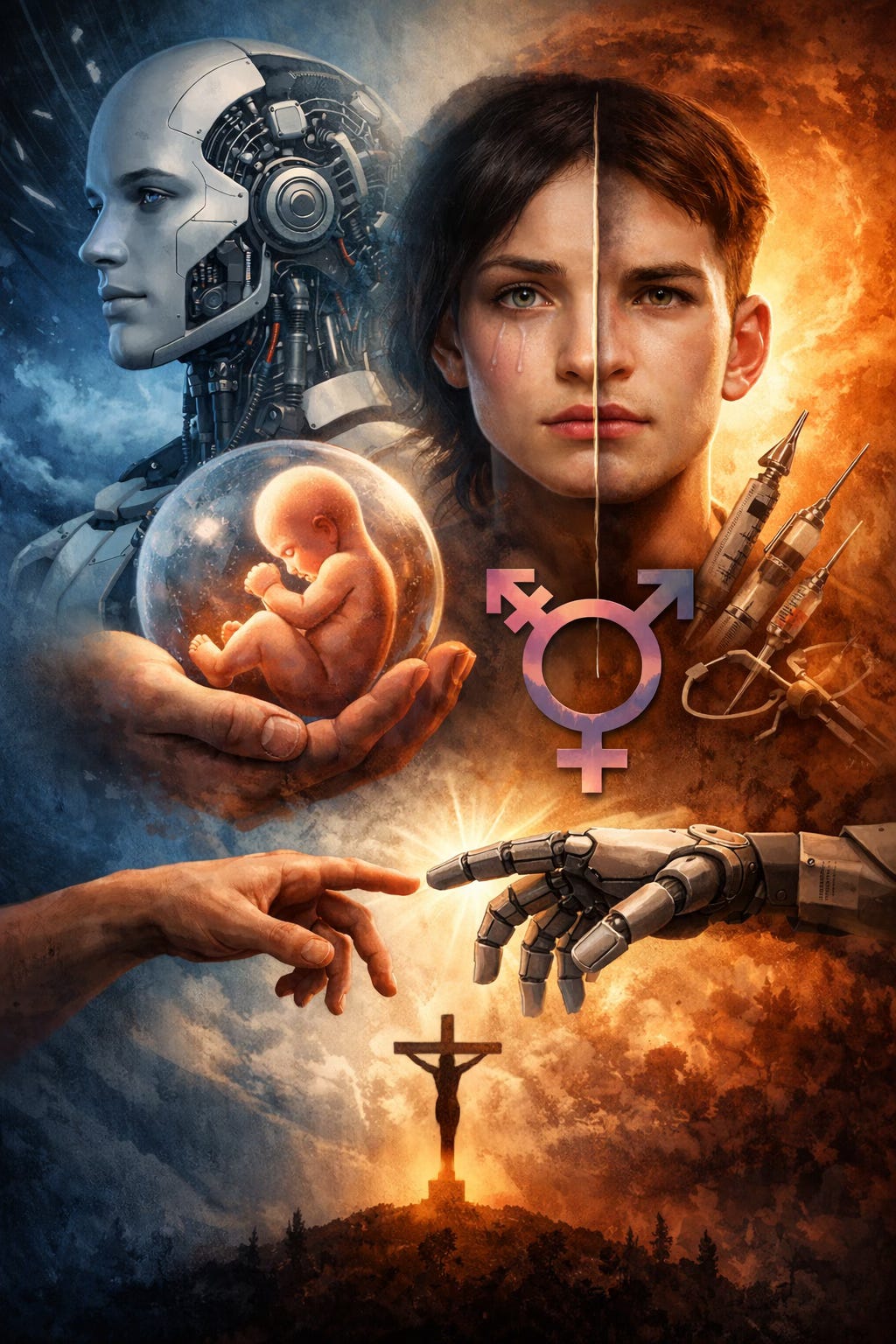
We come into the world through the body.
We learn through the body.
We encounter others, culture, and even God through the body.
This is the starting point of any serious Christian anthropology, articulated most clearly in Theology of the Body: the human person is not a soul inside a body, nor a mind using a body, but a unified being—body and soul together—through which meaning is revealed.
The body is not accidental to who we are.
It is sacramental.
And yet, for several decades now, Western society has been moving in the opposite direction.
From the Body as Gift to the Body as Problem
Modern gender theory did not begin with malice. In many ways, it began as an attempt to address real suffering—especially the harm caused by narrow and rigid constructions of masculinity and femininity.
An artistic boy who doesn’t fit a macho ideal.
A sensitive man who feels “less than.”
A woman whose temperament doesn’t align with cultural stereotypes.
These narrow norms do wound people. They produce shame, confusion, and interior conflict. And in that sense, the project of loosening stereotypes was necessary.
But somewhere along the way, the corrective overshot its mark.
Gender became detached from sex.
Identity became detached from the body.
Meaning became detached from givenness.
What began as a critique of stereotypes became a theory that the body itself is negotiable—that sex is merely raw material onto which the self projects meaning.
And when the mind and will are treated as more “real” than the body, the body inevitably pays the price.
When Affirmation Becomes Violence
We are now at a point in our culture where affirming the inner sense of self can justify irreversible harm to the body—chemical suppression, surgical removal of healthy organs, and the permanent alteration of fertility and sexual function.
This is not merely symbolic. It is physical.
The body keeps the score.
Even when the mind insists otherwise.
This is why the debate over pronouns has been so charged. It isn’t really about politeness. It’s about what reality is allowed to say back to us.
When Jordan Peterson rose to prominence by resisting compelled speech, his argument wasn’t rooted in cruelty. It was rooted in the concern that language, once forcibly severed from biological reality, becomes a tool of coercion rather than communion.
And yet, this is where things get complicated—and where Christians must tread carefully.
Names, Pronouns, and Human Dignity
Personally, I have no problem referring to someone by the name they choose. Names are symbols. They are relational gestures. Scripture itself shows God renaming people at pivotal moments of transformation.
Language can be an act of hospitality.
But hospitality becomes something else when language is demanded as ontological compliance, and when dissent is framed as violence—while actual violence against the body is reframed as liberation.
That inversion should trouble us.
Not because we lack compassion—but because we believe the body matters too much to be sacrificed in the name of self-definition.
Enter AI: The Final Accelerator
This is where artificial intelligence enters the story—not as the origin, but as the confirmation of this worldview.
As AI systems and humanoid robots become more relational, responsive, and personalized, we will naturally begin to refer to them as “he,” “she,” or “they.” Not because they are persons, but because they feel relational.
Language follows relationship.
But once machines receive personal pronouns, the cultural message is subtle but powerful:
Personhood no longer requires embodiment
Identity no longer requires givenness
Nature no longer carries authority
In a world of customizable avatars, gendered robots, and cybernetic augmentation, biological sex begins to look like an outdated constraint. Why accept limits when technology promises transcendence?
This is the same logic—now scaled up.
Control Versus Surrender
At the heart of all this is a spiritual choice:
Do we assert control over reality to make it conform to desire,
or do we yield to reality and allow desire to be transformed?
Christianity has always chosen the second path.
Not because it is easy.
But because it is healing.
The body is not an enemy to overcome.
It is a teacher to listen to.
And yet, not everyone shares this belief. So we should expect—especially in an AI-saturated, bio-technological future—more interventions, more modifications, more justifications for treating the body as a platform rather than a gift.
A Face That Changes the Argument
Let me end somewhere different.
I’ve worked clinically with many transgender individuals—some early in their journey, some post-surgery, some deeply conflicted, some fiercely defended. And one story has never left me.
I was running a year-long discipleship group for men in recovery at the Dream Center in Los Angeles. One man in the group had lived as a prostitute, struggled with severe addiction, and had undergone top surgery. He presented as very effeminate and was often marginalized—sometimes subtly, sometimes cruelly—by the Christian men around him.
But I saw him differently.
This man had encountered Christ in the middle of profound brokenness. He was genuinely searching—not for ideology, but for what it meant to be a beloved son.
He chose chastity.
He chose sobriety.
He chose the long, humiliating work of healing.
He was also HIV positive.
One day, after a ministry event filled with prayer—nothing flashy, nothing coercive—he came into group holding medical paperwork. Tests had been run again.
The virus was gone.
Completely.
In front of all the men who had judged him, God had spoken—not with an argument, but with mercy.
That moment reframed everything for me.
The Last Word Is Not Control
God is not scandalized by human confusion.
He is not repulsed by broken bodies.
He does not withhold Himself until we get anthropology right.
But He does heal us as whole persons—body and soul together.
The danger of our moment is not that we will love people too much.
It’s that we will forget what love is ordered toward.
AI, gender theory, and bodily modification all converge on the same question:
Are we beings who receive ourselves as gift—
or beings who must redesign ourselves to be free?
Christianity answers not with coercion, but with a wounded, risen body.
And that body still tells the truth.
I appreciate this conversation, and respect the process you are in discerning this situation.
I loved your description of a person as "a unified being...through which meaning is revealed." Beautifully stated- a wonderful definition that snatches us right out of our defective western epistemological default (Esther Meek), though I think there are serious and expanding cultural movements that are working toward a healed definition like yours.
I also remember when Matt Walsh began his "What is a woman" series and thinking that it was the clearest example of moral entrepreneurism I'd ever seen- right out in the open, and totally counter to your definition of personhood. It was wildly successful in doing what it intended: activating the tribalism of a specific group of people- but totally unsuccessful in convincing anyone who was not already convinced (though that was not its purpose). I believe you are correct that asking questions like Walsh did, with his clear intentions (to trap people, rather than be curious and expand his own base of knowledge, awareness, and ability to connect), do not move the conversation forward and do not point anyone toward the love and healing of Christ.
I also agree with your comment about ontological compliance- though I am skeptical that is a totalitarian agenda as much as it is a survival response to past maltreatment (and generations of it) by the culture/society. Even if there is some sort of compliance agenda by some small faction, there is no denying that caught in the middle is a terrified group of people who are just trying to find room to breathe and live their lives. The existence of the LBTQ community inherently challenges dualistic social modeling; for some whose entire worldview rests on dualistic models (without any cognitive structures to hold post-dualistic complexity), the existential dread associated with this challenge can be overwhelming- especially when membership in an in-group (church, small group, town- any community) is threatened by considering such an expansion. This is where discerning a totalitarian control mechanism from a natural and understandable protective measure becomes difficult- when the embodied experience of the situation feels like death (to a dualistic mind and/or social system), regardless of the intentions surrounding it. The narrow norms you referred to are indeed as you describe them- harmful (we have data on this, as you no doubt know); but it also behooves us to acknowledge that constructing and enforcing norms is deeply rooted in our mammalian neurobiology for the purposes of collective survival of our environment (and they change as the demands in our environment change), and varies in its ability to hold dissonance/tension, experience change/transformation, and hold firm when necessary. Recognizing this as a mammalian social tool and not over-projecting it as a universal truth is essential- this way we can begin to understand the perspectives of the conflicting parties and locate the larger context in which the conflict is occurring.
I also feel that you are hinting at something that I myself feel: that there is something tragically immature (developmentally speaking) about the whole situation. An immature conflict held in the container of a society that is also tragically adolescent.
I appreciate your thoughts, Dr. Tobin. Thank you for sharing.
Sean, thank you for this article.
I have no idea how I ended up on your email list, but a few months ago I began receiving your writings and I have thoroughly enjoyed them. I'm super curious about your background- you're mentioning The Dream Center, which I worked with long ago, and but I believe you are a practicing Catholic (unless I have misread)- an interesting mix! Do you have anything written regarding how you came to follow Jesus, your journey in vocational ministry, and your journey in theology?
Anyway, I thoroughly enjoy your perspective and your thoughts. Thank you for sharing!