
When Miracles Look Like AI
Holding on to wonder when every sign can be faked.

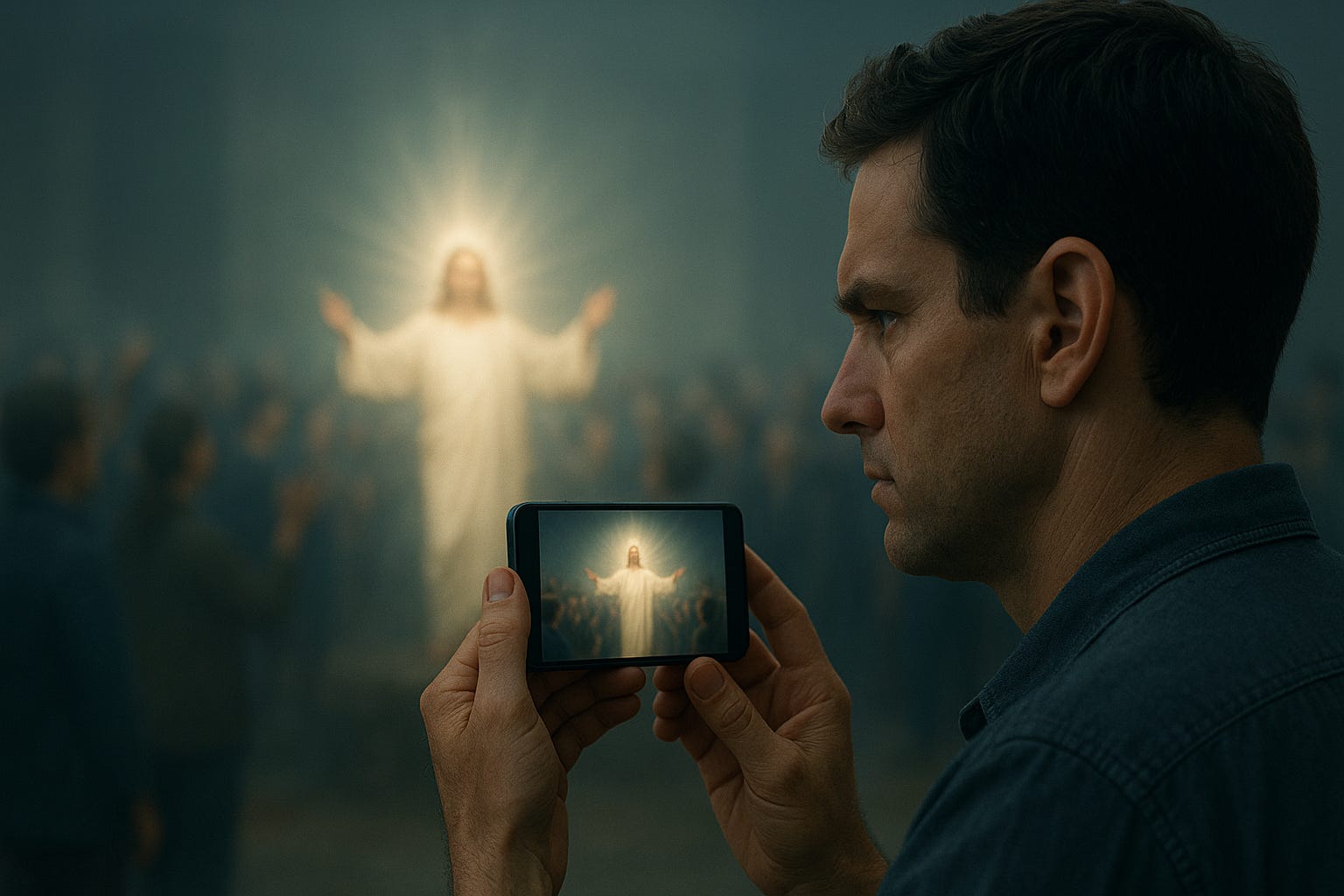
It’s becoming easier every day to fake a miracle.
A healing video goes viral — a man in a wheelchair stands, weeping, worship breaks out — and the comments fill with one line:
“It’s AI-generated.”
I understand it. We live in a world where nothing can’t be edited. Even the real looks rehearsed. Authenticity has been deepfaked into extinction. But here’s the strange irony: the very technology that makes it easier to counterfeit miracles also reveals how miraculous we are.
Artificial intelligence — the ability to create, to compose, to think — is itself a reflection of divine image-bearing. God breathed into dust and made a mind that could imagine. And now, we’ve made a mirror that can imitate imagination itself. It’s astonishing, and terrifying. AI can mimic the appearance of life. But it can’t create a soul.
And that’s the difference.
That’s what makes a miracle a miracle.
When Faith Becomes Empirical
Even in the Gospels, skepticism wasn’t new. When Jesus healed the blind, some praised God. Others accused Him of working by demons. When Lazarus walked out of the tomb, many believed, and others began plotting how to kill Him. Miracles have always provoked two kinds of hearts: the childlike and the cynical.
Jesus knew this. He once said, “Unless you see signs and wonders, you will not believe.” It wasn’t a compliment. It was a diagnosis.
Because faith based only on evidence will always need more evidence.
God still gives signs — not because He owes us proof, but because He loves to reveal His goodness. Yet miracles are not meant to replace faith; they’re meant to provoke it. They expose what’s already within us.
When we encounter something we can’t explain, it surfaces our posture: either awe or armor.
The Gift of Childlike Wonder
My kids don’t ask if the videos are real.
They gasp. They lean in. They ask to watch again. When they see a statue weeping or someone rising from a wheelchair, their first instinct isn’t suspicion — it’s awe.
“Dad, did you see that?”
Yes. And it’s beautiful.
Their wonder doesn’t make them gullible. It makes them receptive. They haven’t yet learned to armor their hearts against mystery. They haven’t been taught that the proper response to the extraordinary is a forensic audit.
And honestly? I want to protect that in them as long as I can.
Because childlike faith isn’t naïveté — it’s wisdom. Jesus Himself said, “Unless you become like little children, you will never enter the kingdom of heaven” (Matthew 18:3). He wasn’t calling us to immaturity. He was calling us to a posture of receptivity, trust, and wonder that refuses to let cynicism become our default mode.
In Big God, Little Devil, I wrote about how St. Thérèse of Lisieux once had a dream where demons tried to frighten her — and fled the moment she looked at them with the gaze of a child. Childlike faith terrifies the enemy precisely because it bypasses all his strategies of doubt and suspicion.
My children remind me of this every time they believe without calculating. They haven’t yet been trained to explain away glory. And maybe that’s the point.
AI can fake videos. But it can’t fake the fruit of a heart that’s still soft enough to believe.
The Age of Explain-Away
The new temptation of our digital age isn’t unbelief — it’s dismissal.
We have an explanation for everything. And if we don’t, we’ll invent one.
A saint levitates? “Hallucination.”
A healing happens? “Placebo.”
A weeping statue? “Condensation.”
A viral miracle video? “AI filter.”
And yet, the more we explain away mystery, the more lifeless our world becomes. Because the opposite of faith isn’t reason — it’s control.
We’d rather feel right than be surprised.
We’d rather dissect glory than be changed by it.
But wonder — true, trembling, childlike wonder — is how faith breathes. It’s the posture that allows us to say, “I don’t understand it, but I know Who does.”
Stewarding the Testimony
This doesn’t mean we throw discernment out the window. AI is flooding the digital landscape. There will be counterfeit miracles — maybe even fabricated “apparitions” — designed to manipulate emotion or mock faith.
But the Church has always faced counterfeit wonders. The answer isn’t cynicism. It’s discernment.
We’re called not just to test spirits — but to stay tender. To steward testimonies with humility and hope, rather than suspicion or spectacle.
In Big God, Little Devil, I wrote that worship and testimony silence accusation. That’s what we’re seeing again. When a real miracle happens, even digital noise can’t drown out its fruit. Peace follows truth. Fear follows falsehood. The difference between manipulation and manifestation isn’t in the video quality — it’s in the presence that remains afterward.
When Jesus healed, He didn’t just restore bodies — He restored belonging. The proof wasn’t the spectacle. It was communion.
Faith in the Age of Fakes
AI will make it easier than ever to counterfeit miracles. But it will also make it impossible to fake the fruits of one.
No algorithm can replicate the peace of Christ. No code can produce the fragrance of holiness. No neural net can generate the humility of a life genuinely touched by God.
That’s the future of evangelization — not proving miracles are real, but living in such joy that people long to believe again.
So maybe we’re entering a time where miracles won’t convince the skeptic — they’ll comfort the seeker.
Where the goal isn’t to win arguments but to awaken wonder.
Where instead of saying, “Look what God did for them,” we begin asking, “What might He do in me?”
The Last Miracle Standing
AI can create faces, voices, even apparitions — but it cannot create love.
It can generate a likeness of devotion, but not the substance of relationship.
Only God can still make something truly new.
Maybe that’s the real miracle of our time: not a video that can’t be explained, but a heart that can’t stay the same.
And that’s one miracle the enemy — digital or demonic — will never be able to imitate.
⸻
If this stirred something in you, share it forward.
Because in an age where even light can be simulated, every real testimony is an act of resistance.
✨ “The light shines in the darkness, and the darkness has not overcome it.” (John 1:5)
I am loving your posts. Thank you for giving of yourself in committing these thoughts to words and in sharing them with us.