
Beyond Lust: What AI Is Really Doing to Human Desire
Pornography, digital intimacy, and why someone always pays the cost

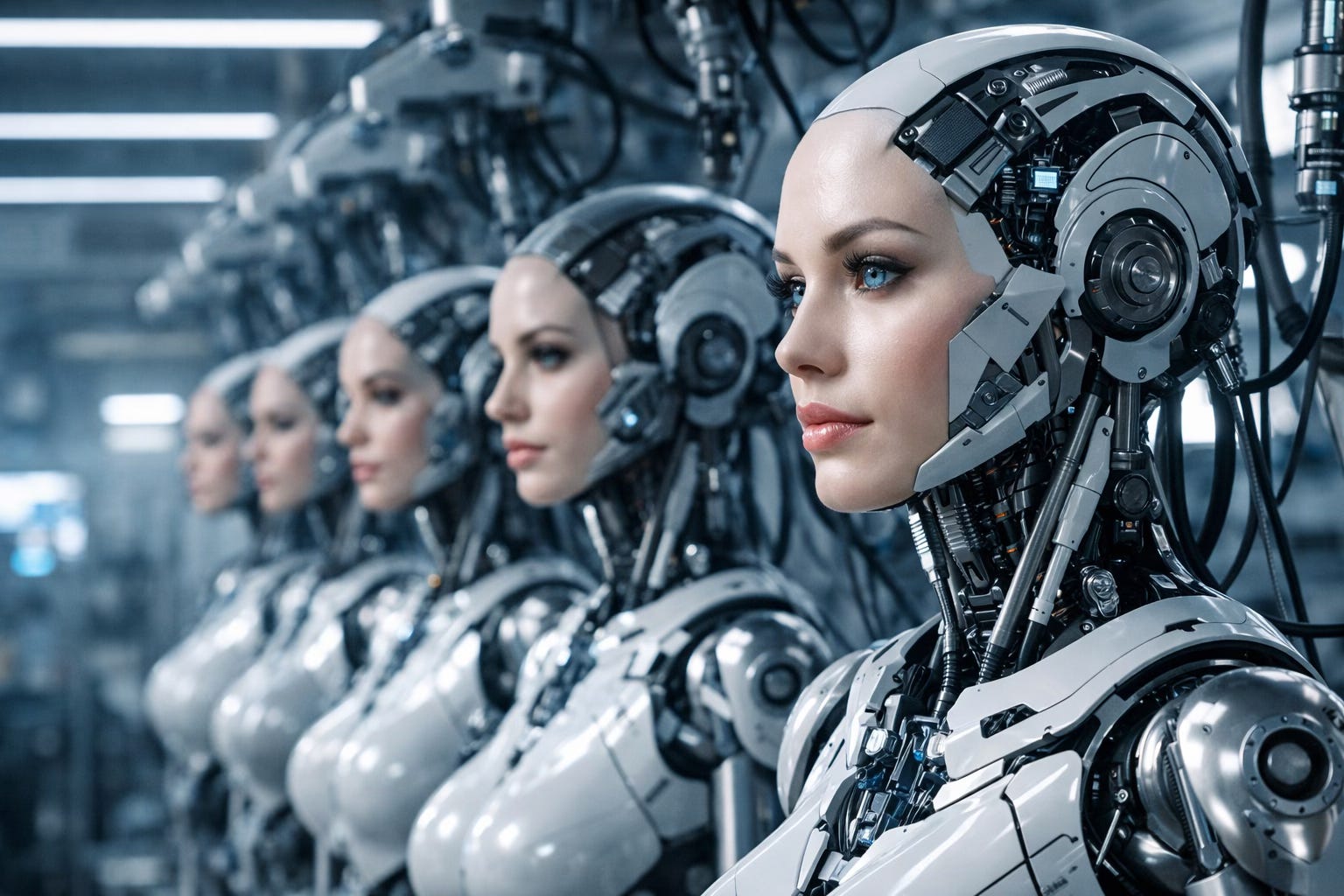
The movie Her was supposed to be speculative fiction.
It isn’t anymore.
Right now, millions of people are emotionally attached to chatbots. Some describe themselves—without irony—as in love. Others spend hours a day confiding in AI “partners” who listen perfectly, affirm endlessly, and never leave. There are already online communities devoted to AI relationships, AI devotion, even forms of AI worship.
Most people have no idea how far this has already gone.
And this year, it’s about to accelerate—fast.
With the explosion of video generation, voice cloning, and real-time avatar interaction, AI companions are about to flood every media space. One of the most surprising—and destabilized—will be the porn industry.
Pornography is about to be disrupted… and not in the way people think
Within a very short window, AI will decimate the traditional porn industry. Not morally—economically.
Why pay performers when AI can generate:
endlessly customizable bodies
perfect responsiveness
infinite novelty
zero production cost
zero consent issues (at least on paper)
Porn stars will likely be among the first creative workers displaced at scale.
And at first glance, that may seem like progress.
No exploitation.
No objectification of real people.
No victims.
But that’s not what actually happens when desire is digitized.
Desire doesn’t disappear. It splits.
AI pornography will feel safer to many people—less morally charged, less personal, less “real.” And for a time, usage may even skyrocket for that reason. But over time, something else happens.
Synthetic desire flattens our capacity for the real.
When desire is trained on:
perfect bodies
instant responsiveness
frictionless affirmation
zero vulnerability
…real people begin to feel slow, inconvenient, and demanding.
Yet the hunger for touch, presence, and bodily confirmation doesn’t vanish.
So what happens?
The fantasy moves to AI.
The body seeks a human.
This is why AI won’t eliminate the sex industry. It will reconfigure it.
And the result may be worse, not better.
Why sex work will likely rise—not fall
As AI absorbs fantasy, personalization, and emotional stimulation, what’s left is the irreducibly human remainder:
skin
warmth
breath
proof of being real
That creates demand for human bodies—not as partners, not as lovers, but as confirmation.
And the people pushed into that role are rarely the powerful or protected. They are the economically vulnerable, the socially invisible, the already-marginalized.
This isn’t about lust alone.
It’s about relocating where human cost is paid.
This is bigger than sex
I recently saw a reel by Ryan Miller, a popular Christian influencer, warning people about an AI girlfriend ad he encountered on YouTube. His concern was the normalization of lust that will lead many into bondage—and he wasn’t wrong.
But this goes far beyond lust.
What’s happening is that AI is stepping in to meet human needs cheaply and cleanly, while quietly shifting the remaining burden onto people who cannot refuse.
Once you see that pattern, it shows up everywhere.
Children raised on AI-mediated attention later needing human containment for anxiety and attachment wounds
Teachers becoming less educators and more emotional regulators
Care work exploding while remaining low-status and underpaid
Presence, companionship, and even touch turning into paid services
AI doesn’t remove need.
It reassigns who must carry it.
The new margins
Every society has margins—people who bear costs others don’t see.
AI doesn’t eliminate margins.
It creates new ones.
There will be those who live with AI—optimized, buffered, insulated from friction.
And there will be those who live under the demands AI creates—whose bodies, nervous systems, time, and emotional labor absorb what machines cannot.
Or more bluntly:
Some people will use AI.
Others will be used by the society AI builds.
The question we keep avoiding
Markets will call this efficiency.
Technology will call it progress.
But the real question is simpler—and harder:
Where does the cost go?
And who is forced to pay it?
Because there is always a person.
There is always a cost.
And we rarely notice the people carrying it—until they’re already standing at the margins.
Note to Readers
This isn’t a fringe issue, and it isn’t limited to a small or deviant minority. We are still living in the midst of a pornography epidemic, which means a large portion of society is already being quietly shaped in how desire, intimacy, and expectation are formed. The shift toward AI-mediated intimacy will touch nearly everyone. Even those who never engage AI dating or synthetic pornography will feel its effects downstream: in relationships that feel thinner, in communities that struggle to sustain attachment, and in social systems that quietly relocate the human cost of intimacy onto the most vulnerable. This is not about private behavior alone; it’s about a cultural transformation already underway, one that will reverberate through families, churches, and the labor force whether we are paying attention or not.
“My people are destroyed for lack of knowledge” (Hosea 4:6)
If this piece helped you, please consider sharing it with others who might need it. And if you’re able, I’d also invite you to consider upgrading to a paid subscription.
In this season, I feel deeply led to keep exploring these spaces—AI, mental health, faith, and human formation—and to keep writing honestly about what’s coming and how we can meet it with clarity and hope. My plan is to expand this work into long-form YouTube content and other media, creating formation resources that make truth, wisdom, and grounded reflection more available in the years ahead.
I can’t do this alone. Your support makes it possible for me to keep doing the slow, careful work of thinking, writing, and teaching in a time when many people are searching for solid ground. If you’d like to be part of that mission, your support truly means more than you know.
These synthetic fantasies are pure lust, which has a profound effect on the human soul. Lust is a bondage, a form of slavery of the passions, which makes love and genuine connection with others more difficult.
This synthetic pornography trains the mind to view others human beings as objects. It will lead to tremendous isolation and cultivate enormously disordered sexual appetites.